
DIY Projects
Kobalt Framing Nailer Review: 24V XTR 30° Cordless Framing Nailer
Eric - East Texas Homestead
January 29, 2026
If you’ve ever put off a “quick” framing repair because dragging out a compressor and air hose felt like a whole project by itself, this tool is aimed directly at that problem. The Kobalt 24V Max XTR 30-degree cordless framing nailer is a battery-powered framing nailer built to handle real framing work, without the compressor, hoses, or gas cartridges.
In my short video review of the Kobalt Framing Nailer, I put it to work in exactly the kind of situation that happens on a homestead: an awkward, tight spot where swinging a hammer is miserable, and where “I’ll do it later” turns into “why is this still broken?” A cordless framing nailer changes what actually gets finished.
What this nailer is (and what it’s designed to do)
This tool is the Kobalt XTR 3-1/2-in 30° Cordless Framing Nailer (bare tool—battery and charger not included). It’s part of Kobalt’s 24V Max XTR line and uses Air Spring technology, meaning it’s fully cordless—no compressor, no air hose, no fuel cell.
Links:
Key specs that matter in the real world
From the manual and product listing, here are the specs that affect what you can build:
- Nail lengths: 2” to 3-1/2”
- Nail diameter range: 0.113” to 0.131”
- Acceptable nail angle: 30°–34° (collated)
- Collation material: Paper
- Magazine capacity: up to 62 nails (varies by nail type)
- Weight: 9.7 lbs
- Speed/runtime (with 4.0Ah battery): up to 3 nails/sec and up to 1,000 nails per charge
It also includes features you’ll actually use:
- Tool-free depth adjustment
- Integrated LED work light
- Dual firing modes: sequential (precision) and contact/bump (speed)
- Dry-fire lockout when you’re down to the last few nails
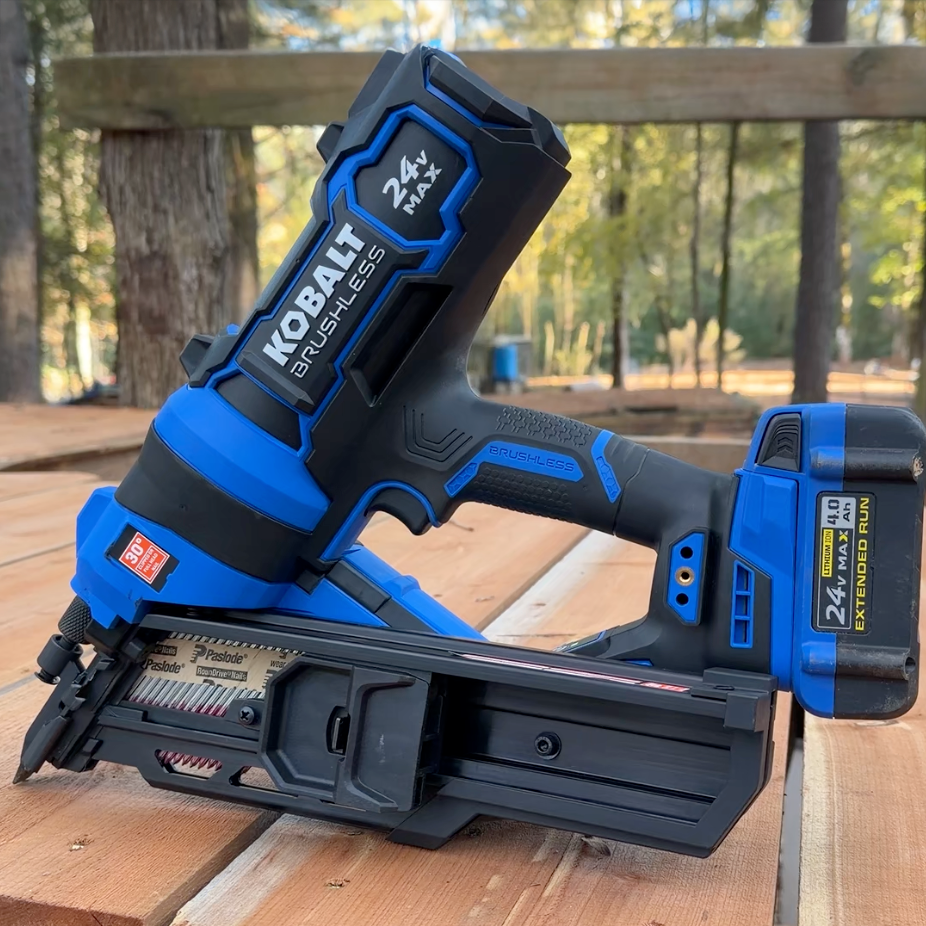
30-degree framing nailer: why the angle matters
A lot of folks searching kobalt framing nailer are really asking: What nails does it use, and why should I care about 30° vs 21° or 24°?
Angle affects two big things:
- Where the nailer fits. Angled magazines can get into tighter bays and corners.
- What nails you can run. This model is built for 30°–34° collated nails.
There are also real-world differences in head style requirements (clipped head vs full round head) depending on what you’re building and local codes. The main takeaway: match the nail angle and nail head style to your application and local requirements.
Why this is a great tool on a homestead
On a homestead, convenience isn’t about being lazy—it’s about finishing jobs before they become bigger problems.
1) You’ll actually do the repair today
When a gate sags, a chicken coop needs bracing, or a shed wall needs a quick fix, a cordless nailer means you’re not setting up an entire air system for 10 minutes of work.
2) No hose, no compressor, no mess
Back of the property. Inside a barn corner. Up on a platform. Around obstacles. The lack of hoses and compressor clutter is a real upgrade in both speed and safety.
3) It’s capable of real framing jobs
This isn’t a brad nailer. This is for projects like:
- Sheds and lean-tos
- Fencing repairs and bracing
- Deck framing and stair stringers
- Wall framing for workshops or solar sheds
- Lumber racks, work benches, and tool stations
- Storm-damage repairs when time matters
Because it supports 2” to 3-1/2” framing nails, you’re covered for most common framing tasks.
Where it fits for non-pros (and where pros might still want it)
For non-pros / DIY builders
This is the sweet spot. If you’re building on weekends, maintaining property, or doing periodic bigger projects, the biggest win is eliminating setup friction while still having real framing capability.
Use sequential mode when accuracy matters (toe-nailing, tight layouts, close work). Use contact/bump mode when you’re running repetitive nails and speed matters. The depth adjustment helps keep your fasteners clean and consistent across different woods.
For pros (certain jobs)
If you’re framing houses all day every day, pneumatics still have advantages in weight and continuous runtime—especially if compressors are already on site. But this nailer makes a lot of sense for:
- Punch lists and small framing corrections
- Remodels where hoses in finished spaces are a pain
- Remote work and service calls
- Jobs where “fast setup” beats “maximum throughput”
And the claim of up to 1,000 nails per charge (with a 4.0Ah battery) can be a legit productivity boost when you’re moving fast and staying mobile.
Practical tips before you buy (so you don’t get the wrong nails)
…make sure you’re buying nails that match what the tool accepts:
- 30°–34° collated nails
- 2”–3-1/2” length
- 0.113”–0.131” diameter
- Paper collation (per the listing)
Also, remember this is typically sold as a bare tool, so you’ll need a compatible Kobalt 24V battery and charger if you don’t already have them.
Bottom line
The Kobalt 24V XTR 30° framing nailer is the kind of tool that earns its keep on a homestead because it removes the biggest barrier to getting framing work done: setup time and hassle. It’s powerful enough for legitimate framing, flexible with nail sizes, and packed with the right features, depth control, LED light, sequential/bump modes, and dry-fire lockout—to make it practical in the real world.
If you’ve got Kobalt 24V batteries already, this is an easy tool to justify, because it helps you turn “I’ll fix it later” into “it’s done.”
Check out the Kobalt Framing Nailer at Lowe’s
Disclaimer I’m a DIY‑homestead enthusiast, not a licensed electrician or contractor. All work shown follows my own safety practices; always verify local codes and wear proper PPE before using power tools. Some links are affiliate links – I earn a small commission if you buy through them, at no extra cost to you.
Share
Recent Posts

February 2, 2026
How to Connect a Mr. Heater 30,000 BTU Vent-Free Blue Flame Propane Heater to a 20 lb Tank (Parts + Video)
What you need to know about the Mr. Heater 30,000 BTU Propane Heater If you’re trying to get reliable backup heat for a...
January 29, 2026
Kobalt Framing Nailer Review: 24V XTR 30° Cordless Framing Nailer
If you’ve ever put off a “quick” framing repair because dragging out a compressor and air hose felt like a whole project by...

April 1, 2025
Spring 2025 Signature Solar Discount Code – 5% OFF EG4 6000XP Inverter (Limited Time!)
Looking for a Signature Solar discount code that works in 2025? Want to to save money on your next solar inverter purchase? You’re...