
Propane Heat
What you need to know about the Mr. Heater 30,000 BTU Propane Heater
If you’re trying to get reliable backup heat for a barn, shop, cabin, or cold room, this guide shows the exact hose/regulator + fitting setup I used to connect a Mr. Heater 30,000 BTU vent-free blue flame propane heater to a standard 20 lb propane tank, plus a simple parts list you can buy on Amazon and a step-by-step video walkthrough.
Watch the video:
Important safety + “window hose” disclaimer
- I’m not a licensed plumber or gas fitter. Follow your local laws/codes and the manufacturer manual.
- Mr. Heater states the propane cylinder must remain outdoors and to check local code for permitted uses (and it’s not for bathrooms/bedrooms/RVs).
- In my video, I show routing a hose through a window. That should be considered emergency/temporary only, not a normal everyday setup. For anything beyond emergency use, do it the right way: proper wall pass-through, proper shutoffs, and code-compliant installation.
What you’ll need (Amazon parts list)
Use your existing affiliate links (these are the ones from your video description):
- Mr. Heater 30,000 BTU heater (check fuel type before buying):
- NEW Recommendation: Mr. Heater F273684 Vent Free Accessory Kit
- Mr. Heater 12-ft hose w/ regulator:
- 90° elbow adapter (3/8” Flare x 3/8” Male NPT):
- Gas line PTFE thread seal tape:
Why I recommend the 90° elbow: it reduces stress/bending at the heater connection and makes the hose routing cleaner (especially in tight installs).
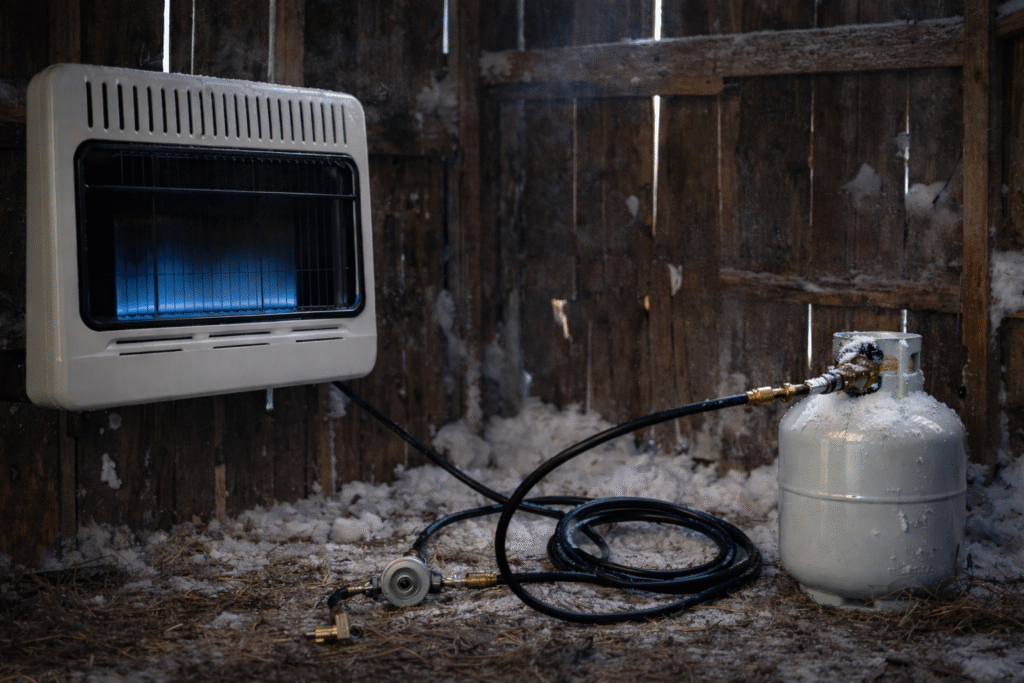
How to Connect a Mr. Heater 30,000 BTU Vent-Free Blue Flame Propane Heater to a 20 lb Tank.
Step-by-step connection (high level)
For the full visual walkthrough, use the video:
Basic sequence:
- Confirm the heater is propane and review the key restrictions (propane tank outdoors, permitted locations, etc.).
- Install the fitting at the heater connection (this is where the 90° elbow helps).
- Connect the hose/regulator to the heater, then connect the regulator end to the 20 lb tank.
- Leak test every joint (soapy water) before lighting.
- Purge air from the hose line (first startup often takes longer).
- Install the AA battery for ignition and light it. Mr. Heater lists “battery ignitor (1-AA)” for this model.
“Mr. Heater says use a 100 lb tank” — why they say that, and why a 20 lb tank still works
You’re not imagining it—manufacturers and heater dealers often recommend larger cylinders because propane has to vaporize (boil) inside the tank fast enough to keep up with the heater. As propane vaporizes, it pulls heat from the tank; in cold weather and/or when the tank is low, the vaporization rate can drop, pressure can sag, and you can see “tank freeze-up” symptoms (weak flame, shutdowns).
Why a bigger tank helps
A larger cylinder has more wetted surface area and more thermal mass, which improves vaporization capacity—especially in colder temps and at lower fill percentages. Tank sizing guidance commonly emphasizes temperature + percent full + tank size as the big variables.
For example, vaporization charts show that even a 100 lb cylinder at low fill and low temperature can have a limited continuous BTU/hr output (numbers drop sharply as the tank gets colder and emptier).
That’s why “use a bigger tank” is a safe blanket recommendation: fewer complaints, fewer cold-weather issues, more consistent performance.
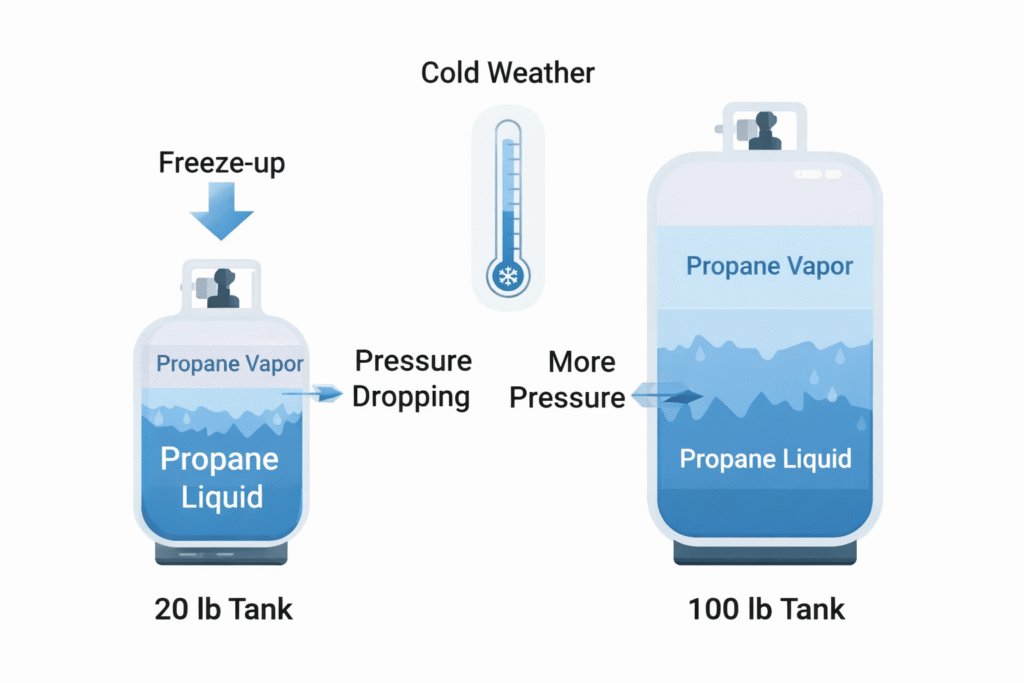
Why a 20 lb tank works in the real world (for backup heat)
Mr. Heater’s current product specs for the MHVFBF30LPT list:
- Minimum tank capacity: 20 lb propane cylinder
- Fuel consumption: ~1.389 lb/hr
- Run time at max BTU: ~14.39 hours
So in normal conditions, a 20 lb tank can absolutely run this heater—especially if:
- You’re not running it flat-out 24/7
- Temps aren’t extreme
- The tank isn’t near-empty
- You keep the tank from getting buried in snow/ice and maintain good airflow around it
Practical advice (what I’d tell a neighbor)
- For occasional/emergency/backup heat: a 20 lb tank is workable and matches Mr. Heater’s published minimum spec.
- For long runtimes, very cold weather, or “I need this to never hiccup”: step up to a bigger cylinder (or manifolded cylinders) to reduce freeze-up/pressure drop risk. Vaporization guidance consistently points to tank size and ambient temperature as limiting factors.
Troubleshooting tips (common issues)
- Won’t light on first install: you may still have air in the line—purge time matters.
- Weak flame / heater shuts down: cold tank, low tank, or not enough vaporization. Larger tank helps.
- Battery/ignition issues: this model uses a 1-AA battery ignitor—verify install and battery condition.
- Any propane smell: shut everything off, ventilate, fix leaks before retrying.
FAQ
Can I keep the propane tank inside?
Mr. Heater’s product page states the propane cylinder must remain outdoors.
Is this meant to be primary heat?
I consider this backup/supplemental heat. Mr. Heater’s own product disclaimer emphasizes local code and location restrictions.
Watch the full install video
Share
Recent Posts

February 2, 2026
How to Connect a Mr. Heater 30,000 BTU Vent-Free Blue Flame Propane Heater to a 20 lb Tank (Parts + Video)
What you need to know about the Mr. Heater 30,000 BTU Propane Heater If you’re trying to get reliable backup heat for a...
January 29, 2026
Kobalt Framing Nailer Review: 24V XTR 30° Cordless Framing Nailer
If you’ve ever put off a “quick” framing repair because dragging out a compressor and air hose felt like a whole project by...
April 1, 2025
Spring 2025 Signature Solar Discount Code – 5% OFF EG4 6000XP Inverter (Limited Time!)
Looking for a Signature Solar discount code that works in 2025? Want to to save money on your next solar inverter purchase? You’re...