
Why This Fuse Block Is on the Homestead
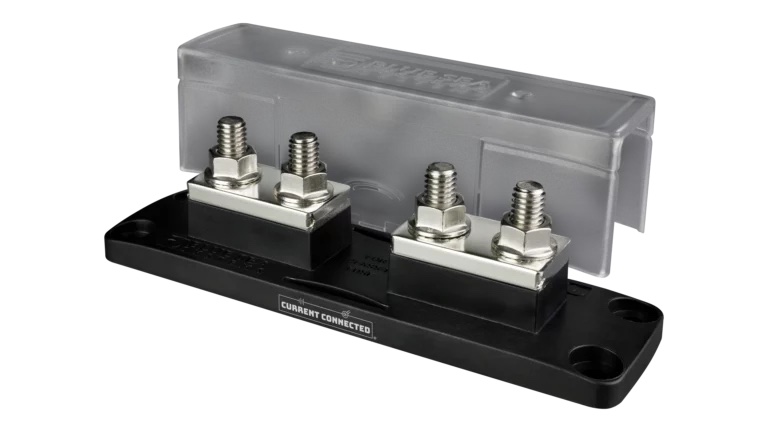
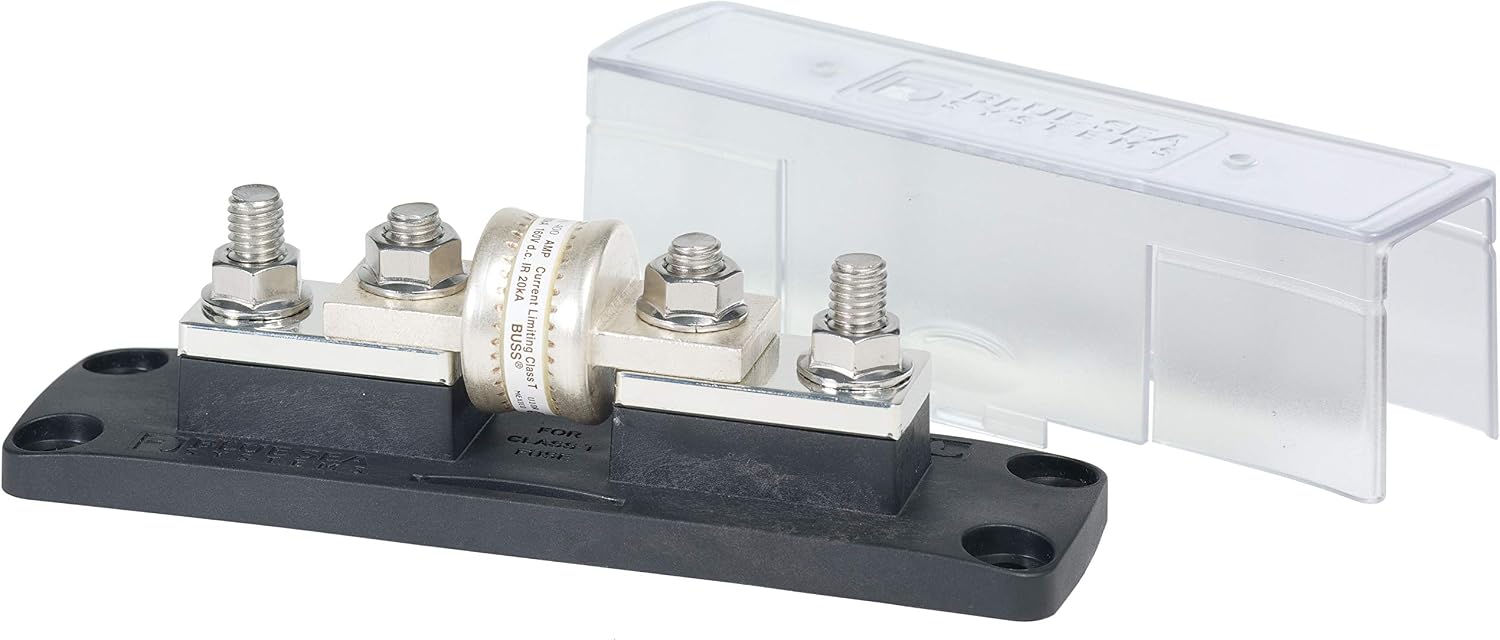
When you’re building a high-current battery bank for an off-grid solar system, a DC breaker alone is not enough. Breakers are great for everyday overcurrent protection, but they are too slow to clear a catastrophic short circuit in a lithium battery bank. That is where a Class T fuse comes in, and the Blue Sea Systems 5502 is the fuse block I trust to hold it.
I use this exact fuse block on my own EG4 battery bank, sitting between the Lynx Distributor and the EG4 12000XP inverter. It is the last line of defense between the battery bank and a dead short. If something goes wrong downstream, this fuse clears the fault in milliseconds, before the breaker even knows what happened.
What Is a Class T Fuse and Why Do You Need One?
A Class T fuse is a fast-acting, high-interrupt-capacity fuse designed for DC battery systems. The key number to understand is the Ampere Interrupt Capacity (AIC). This is the maximum fault current the fuse can safely stop without welding shut or failing dangerously.
Class T fuses are rated at 20,000A AIC at 125V DC. Compare that to common alternatives:
- MRBF terminal fuses: 10,000A AIC at 14V, but only 2,000A at 58V
- ANL fuses: 6,000A AIC, even lower at higher voltages
- Class T fuses: 20,000A AIC at 125V DC, holds its rating across 12V, 24V, and 48V systems
Lithium LiFePO4 batteries have very low internal resistance compared to lead-acid. That means they can deliver enormous short-circuit currents in an instant. A fuse that works fine on a lead-acid bank may weld itself shut on a lithium bank, because the fault current exceeds its AIC rating. The fuse becomes a permanent conductor instead of a protective device. That is a fire.
How I Use It on My System
In my battery rack, the 5502 fuse block sits right after the Lynx Distributor, before the run to the inverter. The path is simple:
- Six EG4 rack batteries feed into a bus bar
- Bus bar connects to the Victron Lynx M10
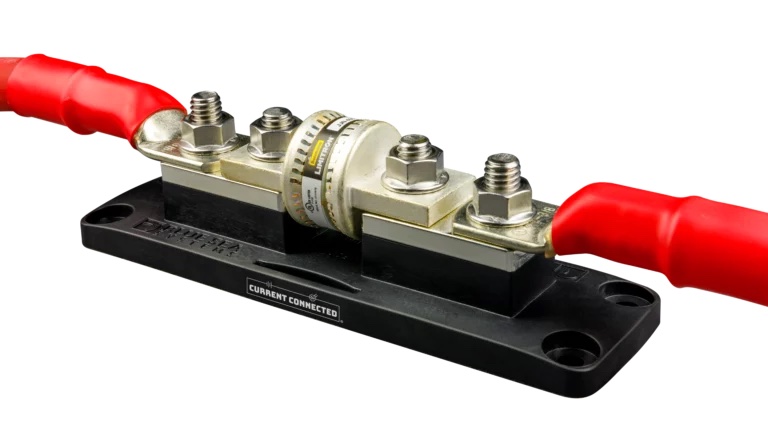
- Lynx M10 feeds through the Blue Sea 5502 with a 250A Class T fuse
- From the fuse block, 4/0 AWG cable runs to the EG4 EG4 12000XP inverter
The 250A fuse matches the inverter’s continuous current rating with enough headroom for surge loads. The 4/0 AWG cable fits the M10 (3/8″-16) terminal studs without any issue, and the tin-plated copper mounting blocks dissipate heat efficiently even under sustained high current.
Specifications
- Part number: Blue Sea Systems 5502
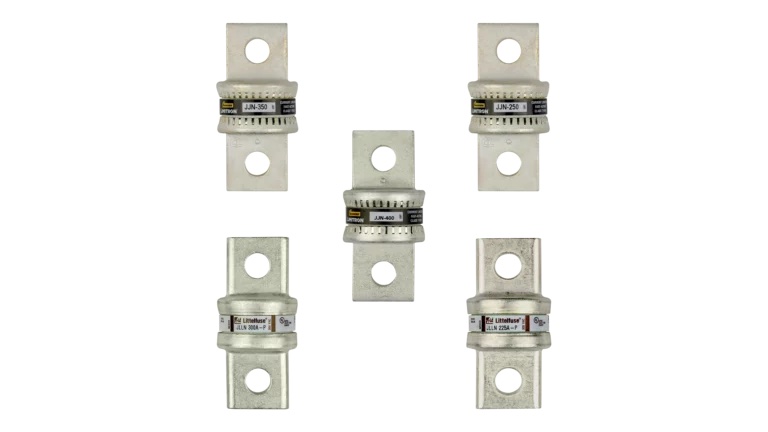
- Fuse range: 225A to 400A Class T fuses (fuse sold separately)
- Max voltage: 160V DC (fuse limited to 125V DC)
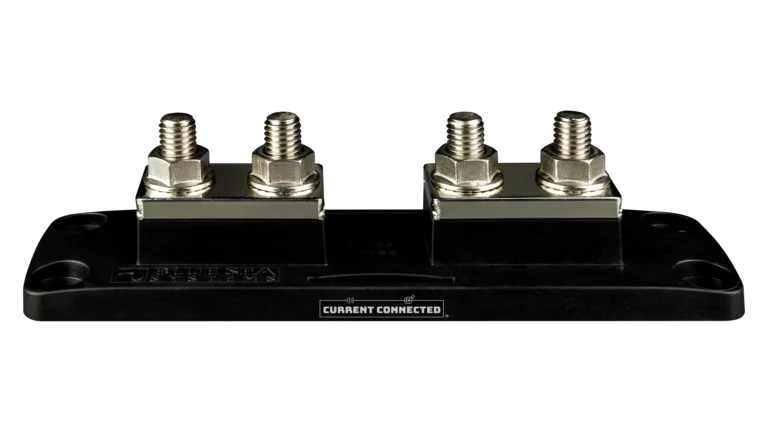
- Terminal studs: M10 (3/8″-16), torque to 190 in-lb (21.5 Nm)
- Max cable size: 4/0 AWG ring terminals
- Dimensions: 7″L x 2″W x 2.3″H
- Construction: Tin-plated copper mounting blocks with insulating cover
- Accessory terminals: Two #8 terminals on each end
- Interrupt capacity: 20,000A AIC (fuse dependent)
What Comes in the Box
The 5502 fuse block ships with the insulating cover and mounting hardware. The fuse is not included. You need to purchase the correct amperage Class T fuse separately based on your system design. For most 12,000W inverter installations on 48V battery banks, a 250A Class T fuse is the common choice.
Installation Tips
- Torque matters: The M10 studs need 190 in-lb (21.5 Nm). Under-torqued connections heat up and cause voltage drop. Over-torqued studs can damage the fuse block. Use a calibrated torque wrench.
- Use the insulating cover: It meets ABYC/USCG insulation requirements and provides additional arc containment if the fuse ever trips under high fault current.
- Mount close to the battery: The fuse should be as close to the positive terminal as possible. Every inch of unprotected cable is a potential fault point.
- Size the fuse to the wire: Continuous load should not exceed 80% of the fuse rating. The fuse protects the wire, not just the inverter.
- Do not skip the fuse block: Bolting a bare Class T fuse between two studs leaves live terminals exposed with no strain relief. The block provides a secure mount, cable management, and insulation.
Pair It With the Right Fuse
This fuse block accepts Class T fuses from 225A to 400A. I run a Blue Sea Systems 5118 Class T 250-Amp fuse in mine, which is the right match for a 12,000W inverter on a 48V battery bank. If you are running a 6,000W inverter, a 225A fuse may be more appropriate. Always check your inverter manufacturer’s DC input overcurrent protection spec before choosing a fuse value.
Check out the latest pricing:


Share
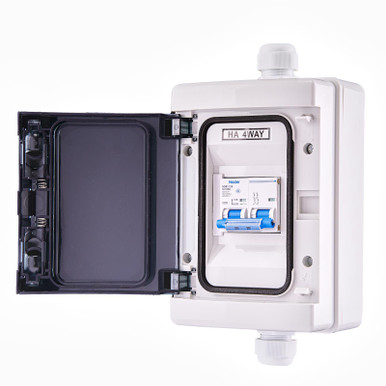
Nader DC Circuit Breaker 60V 200Amp with Enclosure
Why This Breaker Is on the Homestead A Class T fuse handles short-circuit fault protection, but…

Blue Sea Systems 5118 Class T 250-Amp Fuse
Why Blue Sea 5118 Class T 250-Amp Fuse Is on the Homestead Overcurrent protection is not…
Blue Sea 5502 Fuse Block Class T 225-400 Amp
Why This Fuse Block Is on the Homestead When you’re building a high-current battery bank for…