
Why This Breaker Is on the Homestead
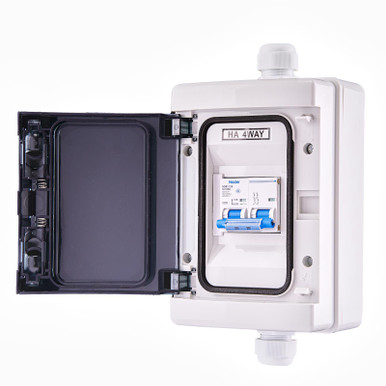
A Class T fuse handles short-circuit fault protection, but you still need a way to disconnect power for maintenance or when an overcurrent condition develops slowly. That is what a DC circuit breaker does. The Nader DC Circuit Breaker sits between my Lynx Distributor and my T-Class fuse, giving me a manual disconnect and overcurrent protection in one unit.
The breaker is rated 60V DC and 200A. One thing to note: the breaker face reads 100A on each pole, but the two poles are paired together to function as a 200A breaker. This is a common design for high-current DC breakers.

Breaker vs Fuse: What Is the Difference?
This is one of the most common questions I get. Both protect your system, but they do different things:
- DC Circuit Breaker: Protects against sustained overcurrent. Can be manually tripped and reset. Good for slow overload conditions and as a disconnect switch. Lower interrupt capacity (typically 6,000A or less).
- Class T Fuse: Protects against catastrophic short circuits. Fast-acting, high interrupt capacity (20,000A AIC). Cannot be reset, must be replaced after blowing. This is your last line of defense against a dead short.
You need both. The breaker handles everyday overcurrent and gives you a disconnect point. The Class T fuse handles the worst-case short circuit that would weld the breaker shut. If I had to choose only one, I would take the Class T fuse, because an uncontained short circuit in a lithium battery bank is a fire. But having both is the right approach.
How I Use It on My System
The Nader breaker sits between the Lynx Distributor and the Class T fuse in my signal path:
- Six EG4 rack LFP batteries feed into a bus bar
- Bus bar connects to the Victron Lynx M10
- Lynx Distributor outputs to the Nader DC breaker (200A)
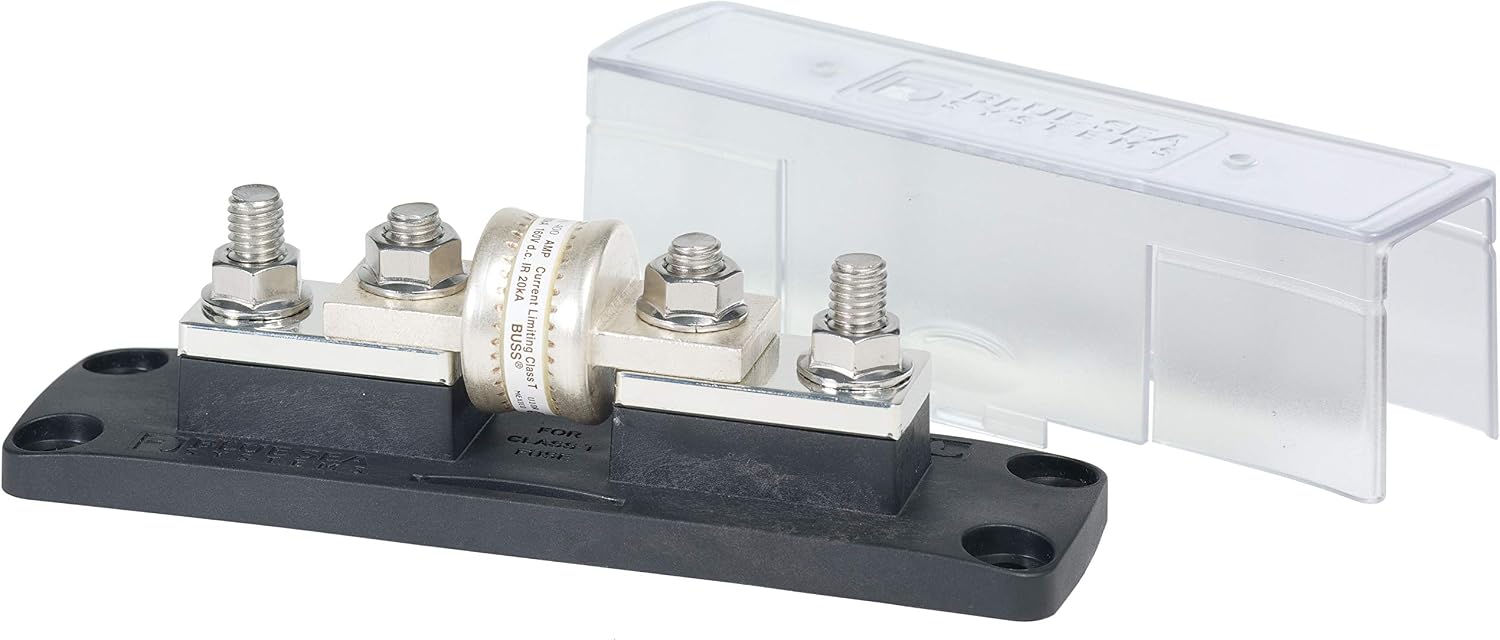
- Breaker feeds the Blue Sea 5502 with a 250A Class T fuse
- Fuse feeds 4/0 AWG cable to the EG4 12000XP inverter
Specifications
- Voltage rating: 60V DC
- Current rating: 200A (two 100A poles paired)
- Type: Thermal-magnetic DC circuit breaker
- Enclosure: Included, covers live terminals
- Mounting: DIN rail or panel mount
- Manual trip: Yes, can be used as a disconnect switch
Installation Tips
- Use the enclosure: The included enclosure covers live terminals and provides additional safety. Do not run the breaker bare.
- Mount before the fuse: The breaker should be upstream of the Class T fuse so you can disconnect power before servicing the fuse.
- Understand the 100A + 100A labeling: The breaker reads 100A on each pole. The two poles work together for 200A total. This is normal for this type of breaker.
- Do not use as your only protection: This breaker does not have the AIC to handle a lithium battery dead short. Pair it with a Class T fuse for fault protection.
Pair It With
This breaker works with the Blue Sea 5502 Class T fuse block and a 250A Class T fuse (Blue Sea 5118) for complete protection. The breaker handles overcurrent and disconnect duty, the Class T handles fault protection. You will also need 4/0 AWG cables to connect the breaker to the fuse block and the fuse block to the EG4 12000XP inverter.
Check out the latest pricing:
Signature Solar
Discount Code:
Auto $50 Discount With Link


Share
Nader DC Circuit Breaker 60V 200Amp with Enclosure
Why This Breaker Is on the Homestead A Class T fuse handles short-circuit fault protection, but…

Blue Sea Systems 5118 Class T 250-Amp Fuse
Why Blue Sea 5118 Class T 250-Amp Fuse Is on the Homestead Overcurrent protection is not…
Blue Sea 5502 Fuse Block Class T 225-400 Amp
Why This Fuse Block Is on the Homestead When you’re building a high-current battery bank for…